
| The Hidden Highway: Heart-Brain Communication |
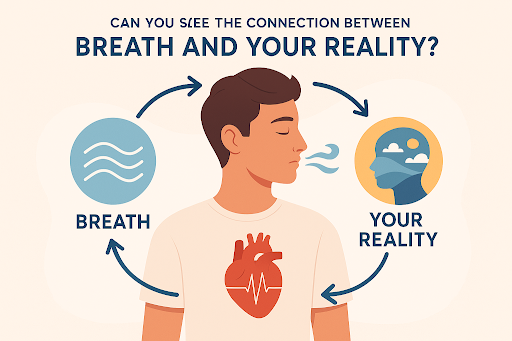
Your breath is more than air moving in and out—it’s a steering wheel for your inner state, shaping how you perceive, interpret, and respond to life in real time. Research from the HeartMath Institute suggests that when breathing shifts, the signals between your heart and brain shift too—changing stress chemistry, emotional tone, and mental clarity. In other words, the way you breathe can quietly influence the “reality” you experience from moment to moment.
HeartMath describes heart-brain communication as a constant, two-way conversation carried through multiple pathways:
- neurological (especially via the vagus nerve and spinal cord),
- biochemical (hormones and neurotransmitters),
- biophysical (pressure waves and rhythms), and
- energetic (the heart’s measurable electromagnetic field).
This isn’t a poetic metaphor—it’s physiology. Your heart is a powerful sensory organ that continuously sends information upward, and your brain continuously sends regulatory signals downward.
What makes this fascinating is that heart-brain communication doesn’t just report what’s happening in the body—it can shape how the brain functions.Patterns in cardiac input influence emotional processing, attention, and the brain’s ability to integrate information under pressure. When the heart’s rhythm becomes erratic (often during stress), the brain tends to shift toward reactive modes; when the rhythm becomes ordered, the brain more easily supports self-regulation, clear thinking, and effective performance.
Think of it like this: the brain is a brilliant strategist, but the heart is a powerful rhythm generator. When the rhythm is chaotic, the whole system has more “noise” to manage; when the rhythm is coherent, the system has a cleaner signal. HeartMath’s core message is empowering: by changing your breathing and emotional focus, you can change the heart’s rhythm pattern—and that pattern can help the brain operate from a more balanced, resourceful state.
| Did You Know?
HeartMath highlights that the heart sends MORE signals to the brain than the brain sends to the heart—meaning your cardiac rhythms can strongly influence how your brain processes emotion and information. |
The Language of the Heart: Understanding HRV
HRV (Heart Rate Variability) is the naturally occurring variation in time between heartbeats. Contrary to what many people assume, a perfectly metronomic heartbeat isn’t the goal—healthy systems are adaptive, and HRV reflects that adaptability. HeartMath frames HRV as the heart’s rhythmic “language,” revealing your stress load, emotional state, and how efficiently your nervous system is regulating moment by moment.
| Two States, Two Patterns |
In a stressed state, HRV often resembles a scribble—irregular spikes and dips that signal incoherence. The body leans toward “fight-or-flight,” with sympathetic activation taking the lead, and the brain prioritizes threat scanning over nuance. Decision-making narrows, emotional triggers land harder, and even simple tasks can feel heavier because the system is spending energy managing internal turbulence.
In a calm, coherent state, the rhythm becomes smoother—more like a steady wave—often clustering around the 0.1 Hz resonance range (about one full cycle every 10 seconds). This pattern reflects more balanced autonomic function and stronger vagal activity, supporting emotional stability and efficient recovery from stress. Many people report that in this state, intuition feels more available, performance becomes more fluid, and it’s easier to choose responses rather than react automatically.
Heart-Focused Breathing: Your Gateway to Coherence
One of HeartMath’s most practical findings is how reliably breathing can shift your physiology. A simple 10-second breathing rhythm—about 5 seconds in and 5 seconds out—tends to guide the body toward the 0.1 Hz resonance range. At this pace, the cardiovascular system, respiratory rhythms, and autonomic regulation can begin to synchronize, making it easier for the heart’s rhythm to become more ordered and for the brain to receive a clearer signal.
This matters because coherence isn’t just a feeling; it’s a measurable pattern associated with more efficient nervous system function. When you breathe at this rhythm, you’re essentially giving your system a steady metronome—one that can “entrain” multiple body systems into a more coordinated mode. Over time, practicing coherence can strengthen your ability to shift out of stress faster, even when life doesn’t slow down.
To make it work in real life, keep the breath gentle rather than forced. Let the inhale and exhale be smooth, and aim for comfort—especially at first. Pairing the rhythm with a sincere positive emotion (like appreciation or care) is a key HeartMath emphasis, because emotional tone strongly influences HRV patterns and helps stabilize coherence rather than creating a “tense calm.”
| Try This Now: The Coherence Breath
• Find a comfortable position • Place attention on your heart area • Breathe slowly: 5 seconds in, 5 seconds out • Continue for 3–5 minutes • Notice the shift in how you feel |
From Breath to Reality: The Coherence Effect
When your breathing helps generate coherence, you’re not just “calming down”—you’re changing the input stream your brain is receiving from the heart. That shift can improve emotional regulation because the nervous system has less internal conflict to manage. Many people notice that situations feel less personally threatening, that they recover faster after being triggered, and that their perception becomes more spacious—creating room for better choices.
HeartMath research and applied training programs commonly report measurable improvements in stress markers, self-regulation capacity, and performance outcomes when people practice HRV-based coherence techniques, supported by scientific research on heart coherence.In practical terms, coherent breathing can support steadier attention, improved working memory under pressure, and more effective decision-making—especially in moments when stress would normally hijack the system. The result is a lived experience that feels different: clearer, less reactive, and more aligned with your intentions.
Over time, this becomes a resilience skill. Instead of waiting for the external world to become “safe” before you feel okay, you build an internal lever you can use anywhere—before a difficult conversation, during a demanding workday, or when you feel overwhelmed. As coherence becomes more familiar, many practitioners describe increased intuitive clarity: not mystical certainty, but a quieter inner environment where subtle signals and wise impulses are easier to detect.
The Science of Transformation
Across studies and clinical applications through 2025, HRV-coherence training and biofeedback are increasingly associated with improved stress resilience, better autonomic balance, and faster nervous system recovery after strain. By practicing techniques that increase HRV order and strengthen vagal activity, people can build a more flexible stress response—one that returns to baseline more efficiently instead of staying stuck in chronic activation.
The most encouraging takeaway is that these changes can be trained. Regular practice appears to support lasting improvements in self-regulation capacity, emotional stability, and performance under pressure—especially when coherence breathing is paired with intentional positive emotion. In that sense, transformation isn’t only a mindset shift; it’s a physiological skill you can rehearse until it becomes more automatic.
Your Breath, Your Choice
Your breath is always with you, which means your point of influence is always with you. By using breathing to shape the heart’s rhythm, you can influence heart-brain communication—and that can change how you process emotion, interpret events, and choose your next action. The outer world may not instantly change, but the “reality” you experience internally can shift in minutes.
Start small: a few minutes of Heart Focused Breathing before you open your inbox, before you drive, or before you speak in a tense moment. If you would like to learn practical HeartMath techniques, Ba’Li Clarity offers a simple introduction to coherence practices.With repetition, coherence becomes less like a technique and more like a familiar state you can return to. That’s the quiet power here: you’re training your system to access clarity on purpose, not by accident.
If you’ve ever felt like life is happening “to” you, coherence practice offers a different experience: life still happens, but you meet it from a steadier center. Breath by breath, you can build a nervous system that recovers faster, a mind that thinks more clearly, and a heart rhythm that supports the best of who you are.
| Key Takeaway
Breathing at a 10-second rhythm supports coherence, which optimizes heart-brain communication, reduces stress load, and can literally change how you process and experience reality. |