
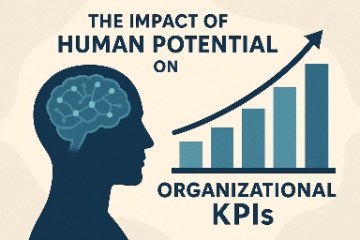
Organizations measure success through Key Performance Indicators (KPIs). Revenue growth, profitability, productivity, customer satisfaction, retention, innovation, .. you name it. Each industry, each organization is monitoring its activity through these KPIs.
Yet, how many organizations are looking at Employee potential as a KPI? How can we measure it, in the 1st place? Do we want to measure such a KPI? Is it relevant for the organization?
The true driver of sustainable organizational performance is the ability of employees to learn, adapt, collaborate, solve problems, and contribute with their unique strengths. We notice here that performance is based on people, therefore if we want to increase performance we need to look at the people. When organizations unlock employee potential, KPIs improve naturally. When potential remains untapped, even the best systems struggle to deliver long-term results.
Today, as organizations across the world face talent shortages, rapid technological change, and increasing workplace stress, employee potential has become a strategic advantage rather than simply a human resources topic.
The Shift From Managing Performance to Developing Potential
While classic metrics remain important, potential looks at something different.
Potential focuses on what employees can become, how quickly they can learn, how effectively they adapt, and how much value they can create in the future.
Organizations that focus solely on current performance often miss opportunities hidden within their workforce. Employees may possess leadership abilities, creative talents, problem-solving skills, or innovative thinking that never gets fully utilized.
So, the question here is: how can we sustain employees who reveal their potential, from the organization level?
The most important thing we can do is to train our employees to manage stress, and regulate their emotions. As long as we limit the time the stress is affecting their body, we limit its long term effects on our physiology. When in neutral mode, the body does not consume energy to regain balance and use it for creation. People have time to pay attention to their heart, and decode the messages coming from there. This alone will increase trust, clarity, creativity and confidence in their own judgement. It is obvious that all these skills, taken to a higher level, are cascading a series of benefits for the company: faster decision-making, improved efficiency, collaboration with colleagues, and focus on the final goal.
Individual benefits are also notable: better relationships, quality communication, time for “want to “ activities, longer resting and restoring breaks.
What else can we do to reveal potential? The classical way – assign tasks from multiple areas and monitor the results. Then have a 1 on 1 meeting with that individual and confirm with him the area he is best of. This process takes a lot of time and may cost organization low efficiency, poor deliverables quality.
In a world where technology evolves at such a rapid pace, we can’t afford to simply “try and see”, we must continuously keep up with develop human potential
Modern organizations are realizing that future growth depends not only on what employees do today, but also on what they are capable of doing tomorrow.
The Engagement Challenge
Recent workforce research highlights a concerning reality.
According to Gallup’s State of the Global Workplace 2026 report, global employee engagement declined to 20% in 2025, the lowest level since 2020. Gallup estimates that low engagement costs the global economy approximately $10 trillion in lost productivity.
In the United States, employee engagement averaged 31% in 2025, continuing a decline from its peak of 36% in 2020. This represents millions fewer engaged employees compared to previous years.
Europe faces a similar challenge. Gallup reports that Europe remains one of the least engaged regions globally, with only 12% of employees engaged while 15% are actively disengaged. Low engagement is consistently linked to lower productivity, higher absenteeism, and increased turnover.
These statistics reveal an important truth:
Many organizations are operating far below their human potential.
Why Employee Potential Drives KPIs
Every organizational KPI is influenced by human behavior.
Revenue growth depends on employee performance.
Customer satisfaction depends on employee interactions.
Innovation depends on employee creativity.
Productivity depends on employee focus and engagement.
Retention depends on employee experience.
When people operate from their strengths and feel connected to meaningful work, they contribute at a higher level.
This creates a direct relationship between employee potential and business outcomes.
Organizations that develop potential often experience:
- Higher productivity
- Better decision-making
- Greater innovation
- Improved customer experience
- Stronger team collaboration
- Higher employee retention
- Better leadership pipelines
In other words, employee potential becomes a leading indicator of future KPI performance.
The Hidden Cost of Untapped Potential
Untapped potential creates invisible losses that rarely appear on financial statements.
Employees who feel underutilized often become disengaged.
Talented individuals may stop sharing ideas.
Innovation slows down.
Problem-solving becomes reactive instead of proactive.
Teams become focused on completing tasks rather than improving systems.
Over time, organizations may experience:
- Reduced adaptability
- Slower growth
- Increased turnover
- Lower morale
- Decreased competitiveness
Many leaders interpret these symptoms as performance issues when they are actually potential issues.
The question is not always whether employees are capable.
The question is whether organizations create environments where capability can flourish.
Potential, Wellbeing, and Performance
One of the most overlooked aspects of employee potential is wellbeing.
Potential cannot thrive when people are operating under constant stress. Recognizing the early recognizing emotional burnout can help employees protect their wellbeing, maintain resilience, and perform at their full potential.
Gallup research shows that employee stress levels remain above pre-pandemic levels worldwide. Employees continue to report significant levels of stress, anger, and emotional strain in the workplace.
When individuals remain in prolonged stress states:
- Cognitive performance declines
- Creativity decreases
- Decision-making becomes reactive
- Collaboration weakens
- Learning capacity is reduced
Organizations often invest heavily in training and development while overlooking the emotional and physiological conditions required for employees to perform at their best.
Developing potential requires more than skills training.
It also requires creating environments where employees can think clearly, manage pressure effectively, and maintain resilience.
Leadership’s Role in Unlocking Potential
Employee potential rarely develops by accident.
Leadership plays a critical role.
Managers influence engagement more than almost any other workplace factor.
Recent Gallup findings show that manager engagement has experienced significant declines in recent years, contributing directly to broader employee disengagement trends.
Strong leaders help employees:
- Discover strengths
- Set meaningful goals
- Build confidence
- Develop new capabilities
- Navigate challenges
- Maintain motivation
When leaders focus exclusively on results, employees often feel managed.
When leaders focus on development, employees feel invested in.
The difference is significant.
Development-focused leadership creates sustainable performance.
Building KPI Systems Around Human Potential
Organizations seeking long-term success should consider balancing outcome metrics with people-development metrics.
Examples include:
Performance KPIs
- Revenue growth
- Customer retention
- Productivity levels
- Project completion rates
Potential KPIs
- Employee engagement
- Learning participation
- Internal promotions
- Leadership readiness
- Employee wellbeing
- Retention of top talent
Together, these metrics create a more complete picture of organizational health.
Strong results today are important.
Strong capability for tomorrow is essential.
The Future Belongs to Organizations That Develop People
The workplace is changing rapidly.
Artificial intelligence, automation, digital transformation, and evolving employee expectations continue to reshape organizations. Recent research shows that AI adoption is accelerating across the U.S. workforce, increasing both opportunities and workplace complexity.
In this environment, competitive advantage no longer comes solely from technology.
Technology can often be replicated.
Human potential cannot.
Organizations that help employees grow, adapt, and contribute their best work will outperform organizations that focus only on short-term metrics.
The future belongs to companies that understand a simple principle:
People are not just resources that drive KPIs.
People are the source of the KPIs.
Final Thoughts
Every organization wants stronger results.
Higher productivity.
Greater innovation.
Better customer experiences.
Sustainable growth.
The path to these outcomes begins with people.
When employees feel engaged, supported, resilient, and able to use their strengths, performance indicators naturally improve.
Organizations that invest in developing employee potential are not simply investing in wellbeing or culture. Through approaches such as emotional regulation, organizations can help employees build emotional resilience, improve self-awareness, and unlock their full potential.
They are investing in the future performance of the business itself.
The strongest KPIs are not created by pressure alone.
They are created when people are given the opportunity to reach their full potential.